What a Certificate of Analysis actually tells you
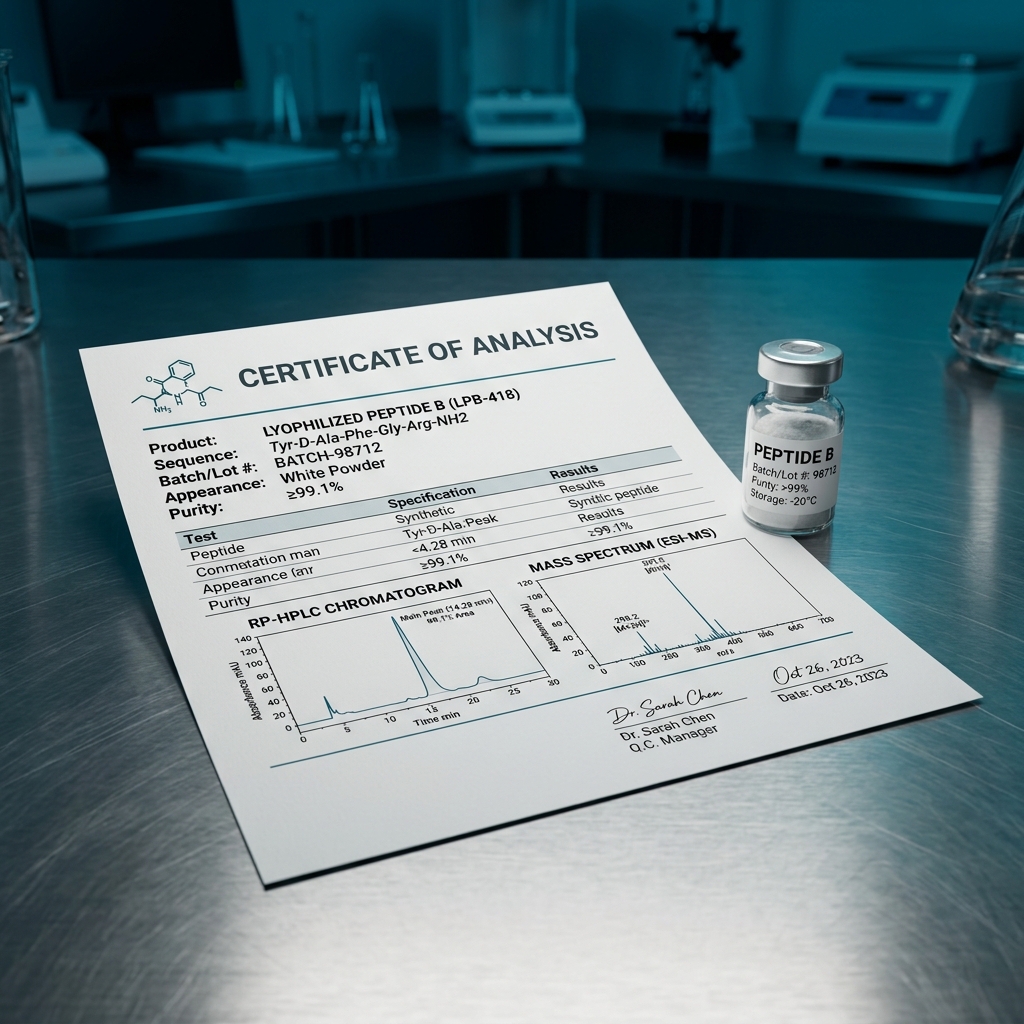
Every lot we ship carries a Certificate of Analysis. It is the single most useful document in the box, and in our experience it is also the least read. This post walks the anatomy of a COA so the next one you open is worth more than a glance.
Identity: is it the right compound?
Identity confirmation usually comes from mass spectrometry. The instrument reports an observed molecular mass, which is compared against the theoretical mass calculated from the amino acid sequence. A match within the instrument’s tolerance confirms you have the compound named on the label — not a related sequence, and not a truncated fragment.
If a COA reports purity but never establishes identity, it has answered the less important question. Purity of what, exactly?
Purity: what the percentage means
Purity on our certificates is determined by reverse-phase HPLC and expressed as a percentage of total peak area. The target compound elutes at a characteristic retention time; everything else in the chromatogram — synthesis by-products, residual reagents, degradation products — shows up as separate peaks.
A figure of ≥99% means the target peak accounts for at least 99% of the total integrated area. It is worth understanding what that does not cover: HPLC-UV only sees species that absorb at the detection wavelength. Residual solvent and counter-ion content are reported separately when relevant.
Lot number: the part that connects paper to vial
The lot number is the join between the document and the physical material in front of you. It is printed on the vial label and appears at the top of the certificate. If those two strings do not match, the certificate does not describe your material — regardless of how good the numbers look.
Every lot we publish is also reachable at its own permanent URL under Lab Results, so a certificate can be verified independently of whatever PDF happens to be in your inbox.
Dates: analysed vs. expiry
The analysis date records when the material was tested. The expiry date is the end of the period over which the material is expected to remain within specification under the storage conditions stated on the certificate. That qualifier does a lot of work — an expiry date assumes the cold chain held. Material stored outside its specified conditions should be treated as being of unknown quality no matter what the printed date says.
How to check a lot in under a minute
- Read the lot number off the vial label.
- Open Lab Results and find that lot.
- Confirm the compound name and the analysis date match what you expect.
- Check the reported purity against the specification you are working to.
- Save the PDF alongside your experimental records.
That last step matters more than it sounds. Reconstructing provenance months later, from memory, is a bad time.